Summary: The study finds that the initiation of atmospheric new particle formation is governed by a single thermodynamic quantity that depends only on temperature and humidity, and verifies this across environments ranging from Beijing and the Tibetan Plateau to a Finnish peatland.
Main content
New particle formation (NPF), in which gas molecules cluster together and grow into aerosol particles, has been observed almost everywhere in the lower atmosphere: in megacities, on remote mountains, in boreal forests and in polar air. It is the dominant source of aerosol number globally and a major source of cloud condensation nuclei, with direct consequences for climate and air quality. Yet despite more than two decades of field campaigns and laboratory experiments, the reasons why NPF happens where and when it does have remained unclear. Temperature in particular has been a long-standing puzzle, with studies reporting that warmer conditions both promote and suppress particle formation.
Dr. Roope Halonen, Assistant Professor at the Nanjing–Helsinki Institute in Atmospheric and Earth System Sciences, Nanjing University, has developed a thermodynamic theory of atmospheric new particle formation showing that the initiation of nucleation is governed mainly by temperature and humidity rather than by the details of the chemistry. The paper, entitled “Thermodynamic origin of atmospheric new particle formation: theory for stable nucleating pairs”, was published online in Proceedings of the National Academy of Sciences (PNAS) on October 12, 2026.
Starting from basic thermodynamic principles, the study shows that for the most important neutral nucleation pathways in the atmosphere, the first step, the binding of one acid molecule to one base molecule into a stable pair, is the decisive step, and that a single quantity controls it: the effective binding free energy of that pair. This quantity depends only on temperature and relative humidity, which act in opposite directions. The result is a condition in which too much is as bad as too little: if the bond is too weak, the pairs evaporate; if it is too strong, the air no longer contains enough precursor vapor to feed them. Nucleation is initiated only within a narrow productive window between the two. Whether an NPF event then actually develops is determined by two complementary factors, the supply of precursor vapors and their loss to pre-existing particles, which together set how fast the process proceeds.
Applied to the sulfuric acid–dimethylamine system, the theory reproduces cluster concentrations measured in laboratory chambers and in the field, including Beijing, the high-altitude Lulang site on the southeastern Tibetan Plateau, and an ultra-pristine peatland in Finland, without any adjustable parameters. It explains why NPF is most active around midday and in spring, why it was observed during a Texas heat wave at temperatures approaching 40 °C, and why it can occasionally occur in the evening in near-pristine air. The framework applies equally to other nucleation chemistries, such as iodine acids in marine air and organic vapors in the cold upper troposphere. The paper is a single-author work by Roope Halonen.
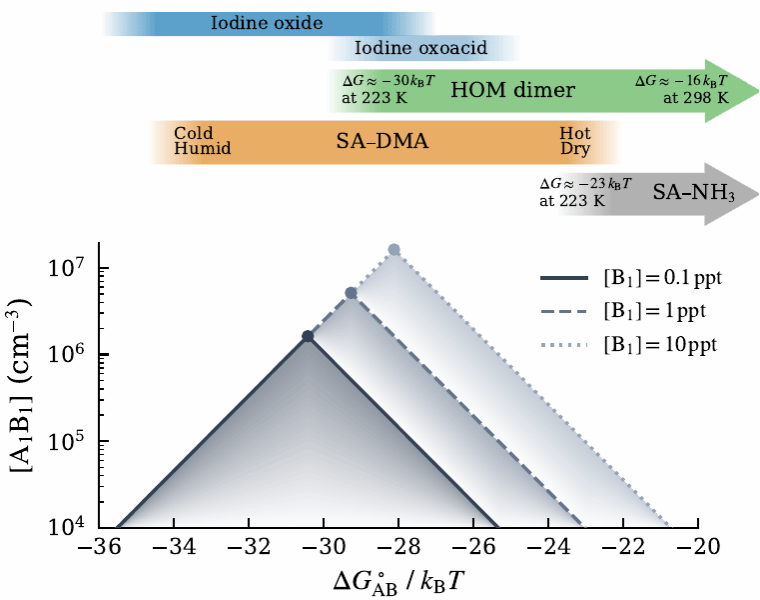
Figure. Too much is as bad as too little: cluster formation peaks when the pair is bound neither too weakly nor too strongly. Temperature and humidity move the atmosphere along this axis.
Paper link: https://doi.org/10.1073/pnas.2620565123
Paper information: Thermodynamic origin of atmospheric new particle formation: theory for stable nucleating pairs. Roope Halonen. Proc. Natl. Acad. Sci. U.S.A. (2026).





 中


